
Free body doubling app for iPhone
ADHD body doubling, for the ten minutes before you start
EarlyBird is a body doubling app built around task initiation. You join a live focus room where other people are already working, name the one thing you are going to finish, and your distracting apps stay blocked until the timer ends.

4.8 on the App Store
No diagnosis needed No camera, no small talk iPhone, iOS 18.2+

The idea
What body doubling is, and why it helps
It is the least impressive productivity technique there is, which is probably why it works when the impressive ones have all been abandoned.
Body doubling means doing your task in the presence of someone else who is also working. The other person does not help, does not check on you and does not need to know what you are doing. Their presence is the entire mechanism.
It has been passed around the ADHD community for years, long before anyone built an app for it. Ask why a library works and you get the same answer every time: you sit down, other people are already working, and the argument in your head about whether to begin simply does not get started. Nothing about the task changed. The room did.
What a body double is not is a supervisor. Being watched tends to make things worse, and plenty of people freeze on camera in a way they never would in a quiet room full of strangers. That distinction shaped the whole app. In an EarlyBird room you can see how many people are focusing and what they are working on, and nobody can see your face, hear you, or tell whether you have moved in twenty minutes.
The searches people arrive with are usually more direct than the theory: improve focus adhd, increase focus adhd, natural focus for adhd. Underneath them is nearly always one specific task that has been moved to tomorrow eleven times. Staying focused with ADHD is the second problem. The first is getting the thing open at all.
Where sessions die
Four places a work session usually falls apart
Each one has a feature attached to it. None of them ask you to be more disciplined than you were yesterday.
-
Starting at all
Task initiation is the expensive part, and no to-do list has ever solved it. A room with people already in it removes the decision: you are not starting, you are joining something that is running.
-
Losing track of time
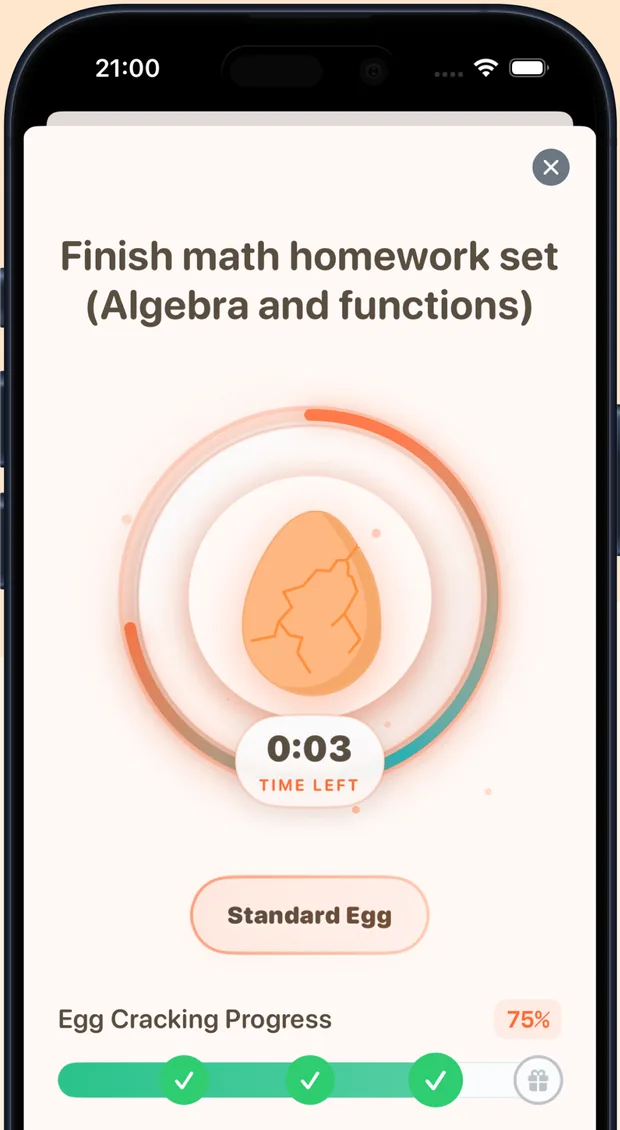
The session ring stays visible while the timer counts down, so the time left is a thing on the screen rather than something you estimate. Afterwards the real length is logged, which is how the estimates slowly get better.
-
The phone winning
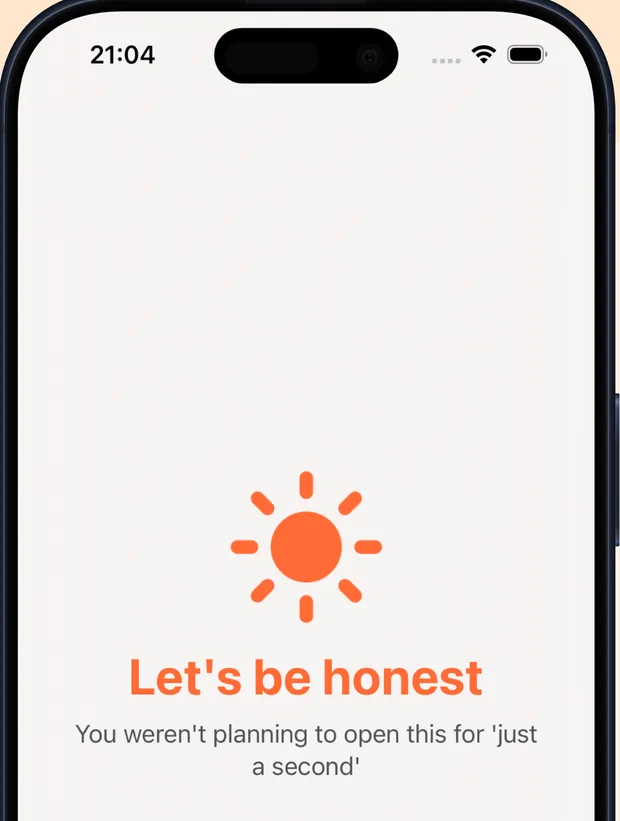
You pick which apps get blocked before the session and iOS holds them shut until it ends. There is no dialog to tap through in the moment your hand has already moved.
-
Not finishing what you said
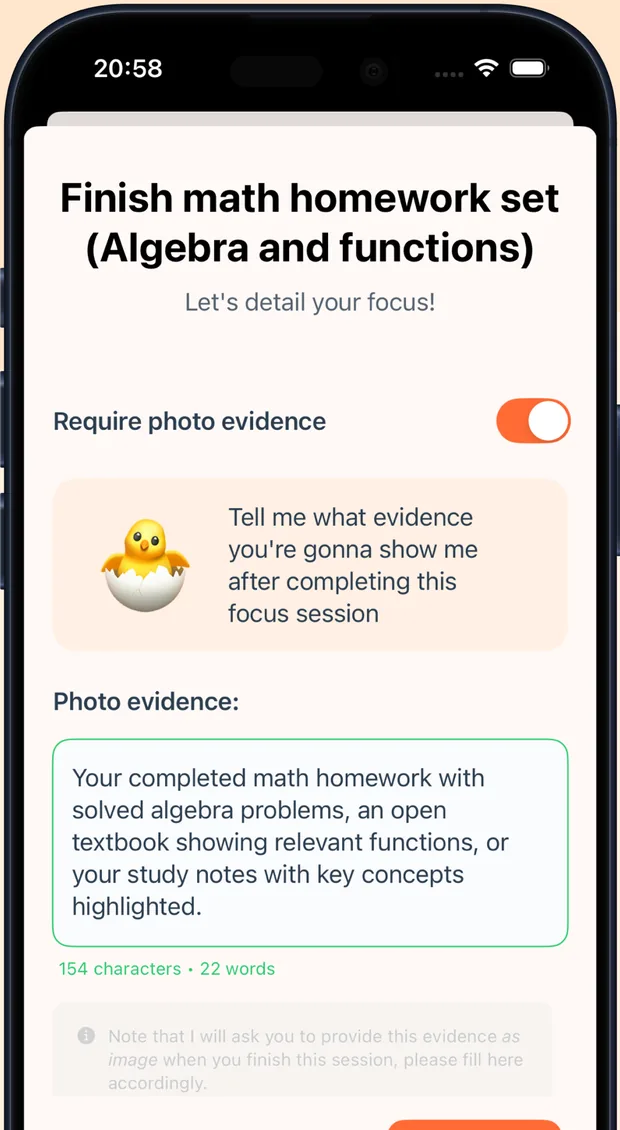
You write the one thing you will get done, and at the end you check in, optionally with a photo of it. Saying it in advance is much harder to quietly abandon than a private intention at 9pm.
There is a fifth problem, which is the day after. Most systems for improving focus with ADHD collapse because they need maintaining: a board to update, a plan to redo, a streak that shames you the moment it breaks. EarlyBird keeps a streak and hatches a chick for every finished deep work session, and that is the whole reward layer. Miss a week and nothing tells you off, because guilt has never once got anyone to open a textbook.
How it works
Three steps, about two minutes
No onboarding survey, no system to set up first. You can be in a session before the urge to reorganise your whole life arrives.
-
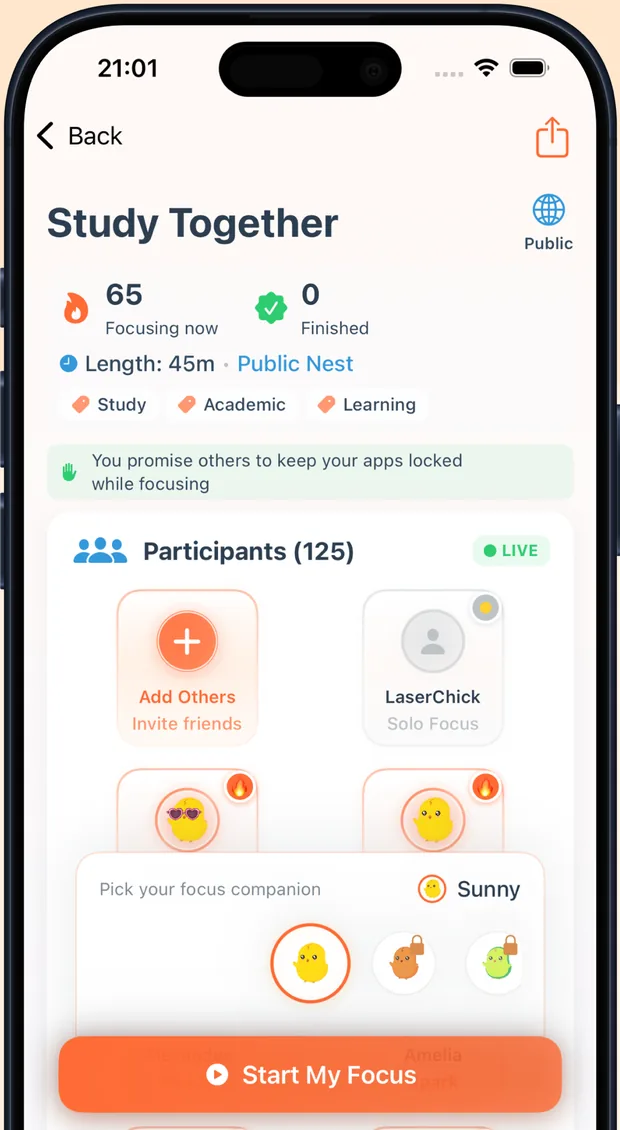
Join a room that is already running
Public rooms run at every hour, including the ones where you are the only person you know who is awake. You can also make a private room for a friend or a study group.
-
Name one task and block the phone
Write the single thing you are going to finish, pick a length, and choose which apps get blocked. One line, not a plan. The shorter the session, the more likely you are to agree to it.
-
Work, then check in
The block holds for the whole session. At the end you check in, the hours go into your stats with whatever tag you gave them, and a chick hatches. Then you close the app.
Worth saying plainly
An app, not a treatment
EarlyBird is a productivity tool. It is not a medical device, not a treatment for ADHD and not a substitute for advice from a clinician. It changes the conditions you work in. It does not claim to change anything about you, and anyone selling you an app that does is selling you something else.
You do not need a diagnosis to use it, and it does not ask about one. Plenty of people who use it have never been assessed and simply lose the first hour of every evening. What it can honestly say is narrow: other people working alongside you makes starting easier, a visible countdown makes time less slippery, and a block your phone enforces removes the negotiation you were going to lose.
-
Study with friends and study rooms
Private rooms for the people you know, public ones for the hours when nobody is available. How the rooms work in detail.
-
The distraction blocker
What the app block does, why it runs on Screen Time permissions, and how it compares with Focus mode and daily app limits.
-
When you cannot focus at all
The longer piece on losing focus while studying, and what to change first if nothing has worked so far.
Questions
ADHD and body doubling: FAQ
What is body doubling in ADHD terms?
Body doubling means doing your task in the presence of another person who is also working. The body double does not help with the task and does not supervise you. Their presence is the point.
It is a long-standing strategy in the ADHD community, and it is why a library or a busy cafe often feels easier to work in than an empty room at home.
Do I need an ADHD diagnosis to use EarlyBird?
No. It is a productivity app and it is open to anyone. It happens to be built around things people with ADHD often find useful, like short sessions with a visible finish line and company at the start, but nothing in it asks about a diagnosis.
Is EarlyBird a treatment for ADHD?
No. It is not a medical device, a treatment or a substitute for professional support. It changes the conditions you work in and nothing else, and it should not be the thing you use instead of talking to a clinician.
Does a visible timer help with time blindness?
Many people find an external countdown easier to work with than an internal sense of how long they have been going. The session ring stays on screen while it runs, and the real length is logged afterwards, so what you estimated and what happened can be compared rather than guessed at.
Is the body doubling app free?
Yes. Joining rooms, running sessions and blocking apps are free. EarlyBird Premium adds unlimited sessions and full statistics for $2.99 per week or $3.99 per month, and the body doubling itself costs nothing.
Do I have to talk or turn my camera on?
No. There is no video and no microphone. You see who is in the room, what they are working on and how long they have left, and that is the entire social layer. The aim is to feel accompanied rather than observed, which matters a lot if being watched makes you freeze.
Get started
There is a room running right now
Free to download, free to join a room, no account needed for your first session. iPhone, iOS 18.2 or later.
On a laptop? Point your phone's camera at this and the App Store page opens on the device that keeps interrupting you.